Fire & Forage
The Land
Remembers
Fire
Fire shaped these landscapes long before anyone managed it. Across the Southeast, periodic burns, deliberate or otherwise, return what decades of suppression took away. The bees are among the first to find what comes back.
Fire is native to these landscapes. Long before suppression policy, lightning started fires, and Indigenous land managers set them deliberately. The result was a patchwork of open woodlands, savannas, and meadows that supported a diversity of native species that has since disappeared from much of their range.
The problem with fire suppression is not only what it prevents. Without fire, invasive plants move in and the canopy thickens. Species that evolved alongside periodic fire find themselves crowded out, starved of light, unable to regenerate. The ecosystem does not adapt around the absence of fire. It simply loses ground.
Prescribed burns reverse that. Done carefully, they remove accumulated fuel, suppress invasives, open the understory, and trigger germination in seeds that have been waiting years for the right conditions. For the plants that built this landscape, fire is not a disruption. It is a signal.
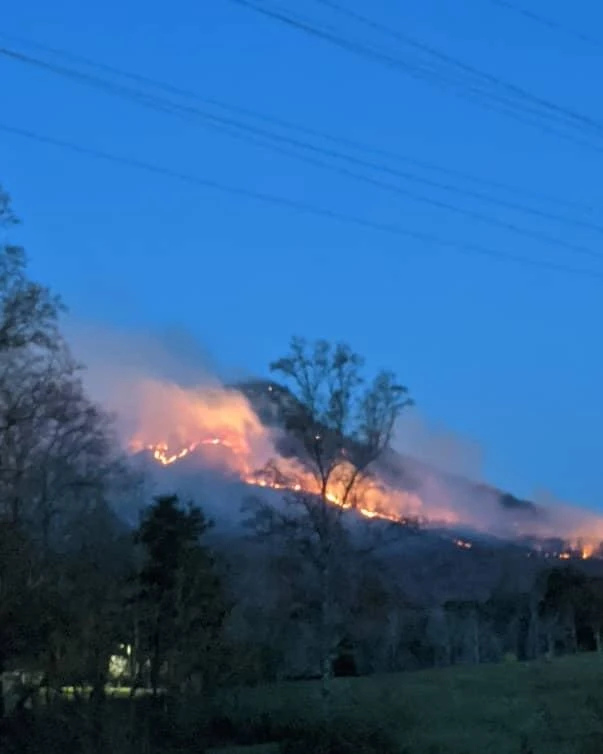
On November 27, 2021, a wildfire ignited on Pilot Mountain in Surry County, two miles from our home apiary. The Grindstone fire was started by an abandoned campfire. It burned across the knob and surrounding slopes before it was contained. It was not a prescribed burn. It was not managed for any particular outcome. It was just fire doing what fire does.
And then the blueberries came back. Wild blueberries had been there all along, holding on in the understory. With the competing growth gone and the soil opened up, they returned in force. By the following spring, the bloom across those burned slopes was substantial.
Our hives work that territory. The wild blueberry flow is brief and early, but the bees find it. Nobody planned for any of that. It just happened.
Nobody planned for the blueberries to come back.
They just did.
Across the Southern Piedmont and Appalachian foothills, many of our most important native nectar plants are fire-adapted or fire-dependent. They evolved in landscapes that burned on a cycle, and their biology reflects it. Suppress the fire long enough and they retreat. Bring it back and they respond quickly.
Sprouts vigorously from established root systems after burns. Fire clears invasive competition and opens the ground layer, producing prolific flowering the following spring.
One of the most prized honey plants in the Southern Appalachians. Thrives in open, well-lit understories. Fire thins competing hardwoods and favors sourwood's persistence in the canopy.
Blooms in open woodlands and along ridgelines. Fire suppression has reduced its habitat significantly. When fire returns, these shrubs establish and flower in the opened understory.
A critical late-season pollen and nectar source. Goldenrod colonizes open ground quickly after disturbance and produces heavy blooms in the years following a burn.
Open-ground species that need disturbance to establish. Post-fire bare patches are ideal seedbeds, and their long bloom window makes them significant contributors to summer forage.
A pioneer species that regenerates aggressively in disturbed and post-fire landscapes. The primary spring honey flow in the NC Piedmont, producing large volumes of high-quality nectar.
The bees do not know the difference between a wildfire and a prescribed burn. They just know what blooms in the year that follows.
These organizations do the research, policy work, and on-the-ground burns that make this possible. If the ecology of fire interests you, these are good places to go deeper.
From shaping the forage in the nearby ecosystem to calming a hive with a little smoke, a beekeeper depends on fire.